When Argentine security forces fired a tear gas grenade at a photojournalist covering a Buenos Aires protest in March 2025, it brought into sharp relief a legal battle already two years in the making, one that has now reached Argentina’s Supreme Court.
Media Defence spoke with Damián Loreti, the Buenos Aires-based lawyer who represents the Press Union of Buenos Aires (SiPreBA) in a landmark class action challenging Resolution 943/23, which press freedom advocates argued effectively criminalised the act of reporting on public demonstrations.
A veteran freedom of expression litigator and secretary of the board of the Centre for Legal and Social Studies (CELS), Loreti had spent more than two years building the case – and in December 2025, a federal administrative court ruled in his clients’ favour, declaring the measure null and incompatible with constitutional and international human rights standards. That ruling is now being contested all the way to Argentina’s Supreme Court.
What follows draws on our conversation to tell the story of how the challenge came about, what it has achieved so far, and why it matters beyond Argentina’s borders.
When Argentine security forces fired a tear gas grenade directly at photojournalist Pablo Grillo as he photographed protesters in Buenos Aires in March 2025, it crystallised what press freedom advocates had been warning since late 2023: that a government security protocol was not just restricting the right to protest, but putting journalists’ lives at risk.
Grillo lost consciousness and required emergency surgery. The injury hospitalised him for many months.
The incident was not an isolated one. It was the foreseeable consequence, critics argued, of Resolution 943/23, a measure issued by Argentina’s Ministry of Security in December 2023, and one that a federal administrative court would ultimately strike down as unconstitutional nearly two years later, in December 2025.
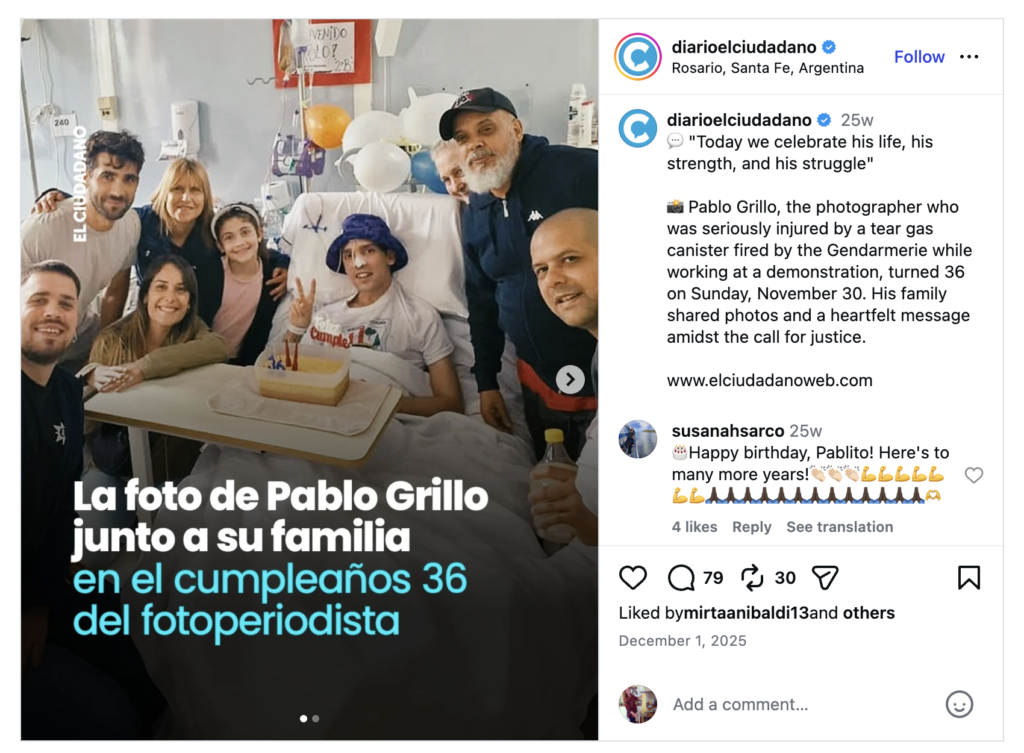
Pablo Grillo celebrating his 36th birthday in hospital with his family on 30 November 2025, more than eight months after being struck by a tear gas canister fired by the Gendarmerie while covering a demonstration in Buenos Aires. Photo: Diario El Ciudadano.
About the Protocol
Resolution 943/23, widely known as the protocolo antipiquetes or “anti-picket protocol,” authorised federal security forces to disperse demonstrations and dismantle roadblocks without a court order.
Its most sweeping provision declared any protest that obstructed traffic to be a flagrante delito, a crime committed in flagrancy, under Article 194 of the Argentine Penal Code. In practical terms, this gave police broad discretionary power to act against demonstrators without judicial oversight, and to make arrests without being required to justify the circumstances to prosecutors.
The human rights implications were immediate and widely condemned. The Inter-American Commission on Human Rights, UN experts, and domestic civil society organisations all raised alarm, arguing the protocol violated international standards on freedom of assembly, freedom of expression, and due process.
CELS challenged the protocol’s constitutionality before the Federal Administrative Court almost immediately after it was enacted.
But the protocol’s effects were not confined to the world of legal argument. On the streets, they were visceral.
Since August 2024, pensioners, many facing destitution amid 200 percent nationwide inflation and receiving only a negligible government bonus atop their minimum pensions, had been gathering every Wednesday in Buenos Aires in what became known as the Marchas de los Jubilados, or Marches of the Retirees.
Police responses were forceful: water cannons, rubber bullets, tear gas. By early 2025, an estimated 800 people had been injured at these marches alone, among them elderly participants, children, and journalists.
The protest of 12 March 2025 proved a turning point. More than 800 police personnel were deployed. Over twenty people were hospitalised, over 100 were detained, including two children, and nearly all were released within hours because prosecutors had no information about why they had been arrested in the first place.
At least fifteen journalists were obstructed from reporting. Pablo Grillo was among those seriously injured. According to SiPreBA, more than 50 press workers had been affected by rubber bullets and tear gas in 2024 and early 2025 combined.
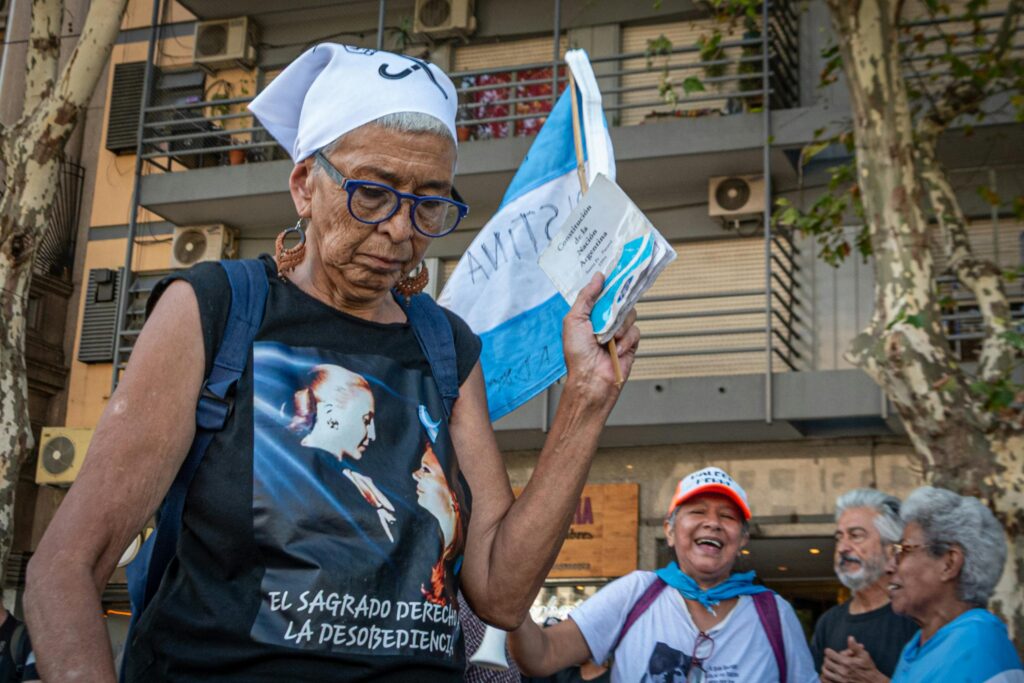
A protester at one of the Marchas de los Jubilados holds an Argentine flag and a copy of the national constitution. Her t-shirt reads “El sagrado derecho a la desobediencia” — “The sacred right to disobedience.” Photo: Juan Moccagatta/Pexels.
Why the Press Union Joined the Class Action
The legal challenge had opened for accessions in December 2024, when CELS invited other organisations to join as co-petitioners. SiPreBA joined alongside Amnesty International Argentina, the ATE state workers’ union, and several other civil society groups. Each participating organisation was represented by its own legal counsel; Loreti acted for SiPreBA.
Loreti explained that the union decided to join for two reasons. As workers, union members have their own right to protest, a right the protocol restricted. And as journalists, their ability to cover demonstrations safely was directly threatened. “The way this right to assembly [would have been] restricted exposes the journalists to a security risk and restriction to freedom of information.”
“Universally, there is a risk when journalists cover demonstrations and when they are repressed,” he added, pointing to Grillo as the starkest example. “He was at the hospital for 10 months.”
“Under this protocol, every single protest or demonstration is considered an illegal interruption of transit or public circulation and a state of emergency.”
Damián Loreti
The Legal Arguments That Won at First Instance
Following the escalation at the 12 March 2025 protest, the class action parties filed an urgent request for precautionary measures with the Federal Administrative Court on 16 March.
They asked the court to order the Ministry of Security to instruct security forces to comply with UN standards on the use of force, to adopt concrete accountability measures for each operation, to guarantee the safety of journalists covering protests, and to suspend Resolution 943/23 entirely.
The court initially declined the request to provisionally suspend the resolution pending the proceedings. However, the presiding judge personally attended the 19 March 2025 demonstration to observe proceedings firsthand, an occasion on which no arrests or injuries were reported. The class action parties argued that, despite there being no arrests on this occasion, the resolution undoubtedly enables the security forces to carry out arbitrary arrests, pointing to the mass detentions of 12 March, the majority of which resulted in release within hours and without charge. This was not an isolated incident but a pattern that repeated itself on numerous subsequent occasions.
In December 2025, the Federal Administrative Court ruled in favour of the class action parties, declaring Resolution 943/23 null, finding it insufficiently justified and incompatible with constitutional protections of freedom of expression and assembly, as well as Argentina’s international human rights obligations.
When asked what arguments proved decisive, Loreti identified two central failings of the protocol. “The first was that it reinterpreted Article 194 of the Criminal Code. Under this reinterpretation, every single protest or demonstration is considered an illegal interruption of transit or public circulation and a state of emergency.”
The second failing was perhaps more fundamental. The protocol made no reference whatsoever to international human rights standards. “The Ministry did not include a single line addressing the obligation to make conditionality controls under international human rights standards. This resolution regulates and restricts human rights such as freedom of expression and freedom of assembly, and there is nothing relating to that [in the resolution].”
In short, the executive branch had exceeded its authority twice over: by reinterpreting the Criminal Code in a manner beyond its competence, and by regulating fundamental rights without any reference to the international human rights framework that should constrain such regulation. “I would say these are the most important issues,” Loreti said.
The ruling also carried significance for the way it was reasoned. In correspondence with Media Defence following the judgment, Loreti noted that the judge had carried out “a review of conventionality, which is quite atypical.” This control de convencionalidad, the practice of measuring domestic law against the Inter-American Convention on Human Rights, is not routine in Argentine administrative courts, making its inclusion here a meaningful signal.
A Deteriorating Landscape
The current climate stands in stark contrast to the direction Argentina had been travelling. Since the restoration of democracy in 1983, the country had built a comparatively progressive legal framework for press freedom: contempt and criminal defamation laws were removed from the penal code, source confidentiality was guaranteed, and the landmark Kimel ruling reinforced the principle that journalism on matters of public interest deserved strong protection.
Freedom of expression, as Loreti notes, is a value that Argentines have long held as a point of national pride. That makes the current trajectory all the more alarming.
Since President Javier Milei took office in December 2023, the environment for journalists has deteriorated markedly. In just four years, Argentina’s ranking in the Reporters Without Borders’ World Press Freedom Index fell from 29th place in 2022 to 98th in 2026.
The Inter-American Commission on Human Rights, in its 2024 Annual Report, flagged the regression in press freedom as significant and worrying.
Loreti’s assessment is unequivocal. “Every single organisation in Argentina is saying the same thing: unions, non-unionised press associations, media owners, civil society organisations like Amnesty International, CELS, and FOPEA — there is a unanimous worry in relation to the deteriorating state of press freedom.”
He described a confluence of pressures: the normalisation of hostility towards journalists; the use of civil and criminal litigation to silence critical voices; and a legislative agenda that has sought to repeal the Professional Journalists Act, which contains key labour protections and provisions safeguarding freedom of expression and access to information.
The closure of the leading national news agency Télam in 2024 dealt an additional blow to information pluralism.
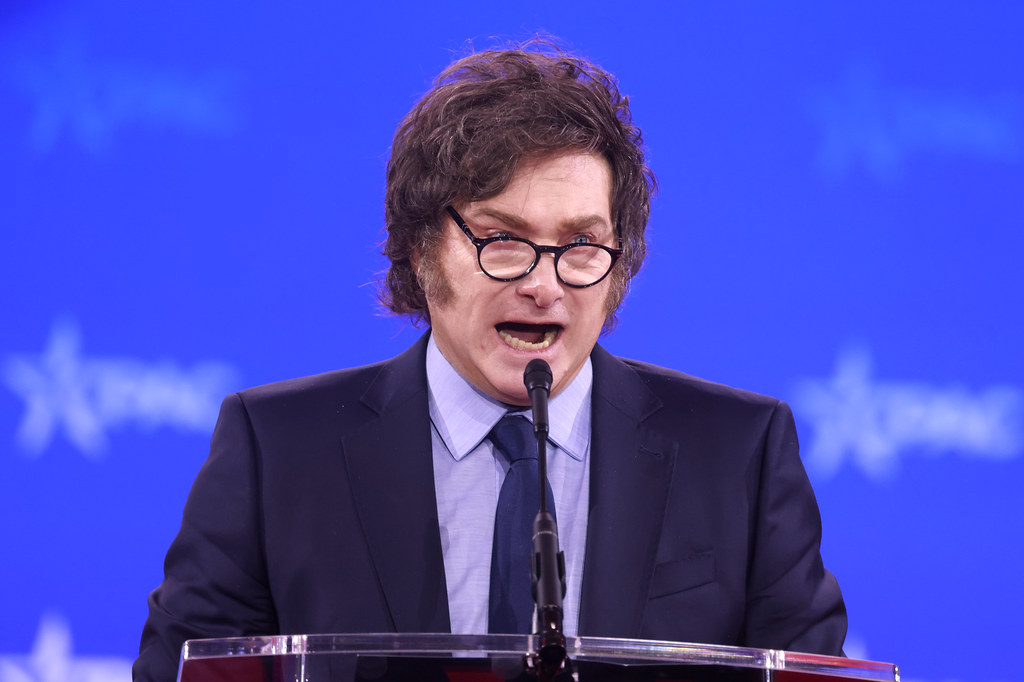
“We don’t hate journalists enough.”
Argentine President Javier Milei
The rhetoric from the top has been inflammatory. An analysis by FOPEA (the Argentine Journalism Forum), titled The Insult as a Strategy, scraped over 113,000 posts from Milei’s X account between December 2023 and September 2025 and found the president had repeatedly referred to journalists using terms including “criminals,” “corrupt,” and “terrorists.” Critically, the report also found that journalists are routinely framed as political opponents and dismissed as “kukas”, a pejorative for supporters of Kirchnerism, the left-wing political movement associated with the Kirchner governments, a tactic that serves to delegitimise critical coverage as partisan rather than journalistic.
A survey by LA NACION laid bare the scale of Milei’s latest social media offensive against the press. Over the long Easter weekend in April 2026, he spent more than 14 hours on X, posting 86 messages and retweeting a further 874, with 90% of them targeting journalists directly. The barrage was amplified by a chorus of attacks from politicians, ministers, and legislators alike. Later that month the campaign reached a crescendo with Milei banning the entire press corps from the Casa Rosada, Argentina’s seat of government. The ban was overturned just a week later, following backlash from lawmakers and press freedom advocates.
Loreti recalls one of Milei’s most widely quoted lines, which encapsulates the tone: “We don’t hate journalists enough.”
The official posture towards the press has at times been explicit. Ahead of operations at Congress in February 2026, the Ministry of National Security issued a formal communiqué advising journalists to avoid positioning themselves between security forces and protesters while covering demonstrations, warning that if violence broke out, the forces would act, and that any journalist caught in the middle would be considered to have placed themselves in danger of their own accord.
The document used the legalistic phrase autopuesta en peligro, self-imposed endangerment, to pre-emptively shift responsibility for any harm onto the press. It was, as Loreti put it, “a kind of threat.”
For Loreti, this kind of conduct is not rhetorical excess but a historical marker. Measured against the reforms that followed Kimel, he warns of “the most serious threats to press freedom we have seen since the reform of the Criminal Code following the landmark Kimel v. Argentina case.”
A fake news office, modelled on a similar initiative in the United States, has also been established. It was established abruptly and without prior notice, Loreti noted in correspondence with Media Defence in December 2025. The implication, of state apparatus being turned towards policing and stigmatising media narratives, is not lost on those who have watched the incremental erosion of press freedom under the current administration.
From the Streets to the Supreme Court
The December 2025 judgment was a significant victory, but it was swiftly challenged.
The government appealed, and on 31 March 2026, the Federal Court of Appeals (Chamber III) overturned the first-instance ruling, declaring Resolution 943/23 lawful. The appellate court found that the protocol had been legitimately enacted and that the constitutional arguments raised by CELS and its co-petitioners did not, in its view, warrant striking it down.
It was a significant setback, but not the end of the road. CELS, SiPreBA, and Amnesty International Argentina filed an extraordinary federal appeal in April 2026, seeking to bring the case before Argentina’s Supreme Court. And on 19 May 2026, the Court of Appeals conceded partially, granting the appeal and ordering that the case be forwarded.
The Supreme Court will now have the final say on whether the executive branch exceeded its authority in issuing the protocol and on whether the constitutional rights to freedom of expression and assembly require it to be struck down.
It is the highest judicial forum available in Argentina, and the fact that the case has reached it is itself a testament to the strength and persistence of the legal challenge CELS, the Press Union of Buenos Aires and its partners have built.
Loreti was careful to frame the significance correctly. “The protocol doesn’t say a word about journalists. This case is not specifically about journalists’ rights, [the impact on journalists] is a collateral, but very significant problem.” The core issue, he argued, is one of democratic accountability: who monitors what police do during demonstrations, and who informs the public about what is happening in the streets?
The case’s broader resonance extends beyond Argentina’s borders. “Consider the new ways in which states are regulating demonstrations,” Loreti said, pointing to comparable trends in the United States and elsewhere. “The significance of this court decision is broad: the ruling affirms that both executive and judicial branches must apply international human rights conventions, and specifically, standards relating to freedom of expression. This is very, very important.”
For the journalists injured on the streets, for those who went to court to protect them, and for Loreti, it now reaches its most consequential stage yet. Argentina’s Supreme Court will decide whether the government’s anti-picket protocol has a place in a constitutional democracy on the principle that executive powers have limits, and that reporting on what happens in the streets is not a crime.
Media Defence awarded a grant through its Strategic Litigation Programme to lawyer Damián Loreti for his representation of SiPreBA in this class action.
